Political Science · Heidelberg University Research Assistant · GESIS / European Social Survey
I am a master's student in political science at Heidelberg University and a research assistant with the European Social Survey (ESS) Team at GESIS – Leibniz Institute for the Social Sciences.
My research focuses on American politics, particularly political polarization, political psychology, extreme attitudes, and violent behavior. I am also interested in survey methodology and respondent psychology.
Upcoming talks
Two papers accepted for the Political Studies Association (PSA) Annual International Conference, University of Hull, UK, March 2027. details ↓
Selected research figure
Violent political behavior in the United States
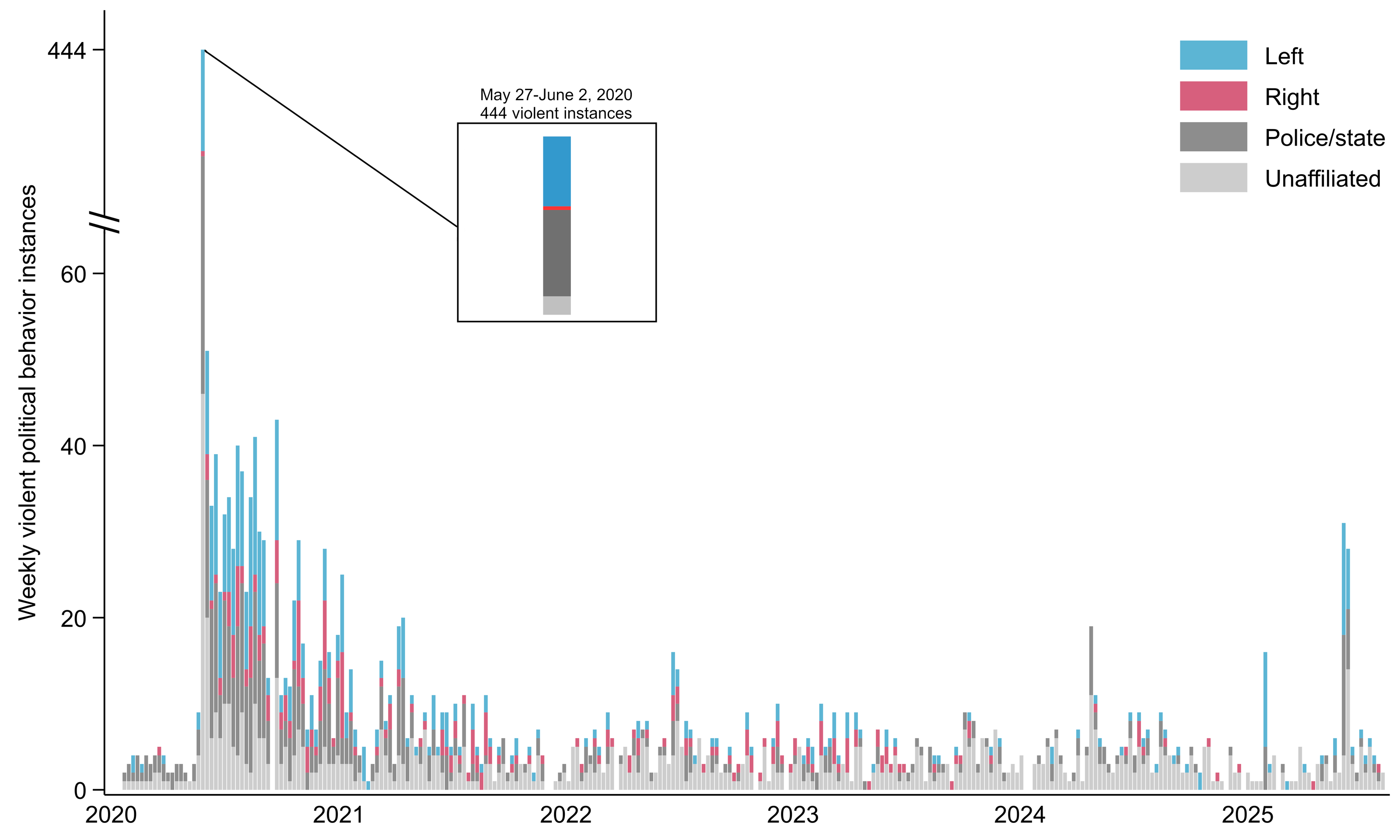
Weekly distribution of violent political behavior, 2020–2025. Figure 1 from Violent Political Behavior in the United States: Measurement, Ideological Composition, and Dynamics (2026). research details ↓full-size figure ↗
Research
Manuscripts
Violent Political Behavior in the United States: Measurement, Ideological Composition, and Dynamics
Azat Rakhmanberdiev · 2026 · Under review at Political Studies
American public debate is increasingly shaped by fears that partisan hostility is spilling into physical conflict. While studies suggest political violence in the United States is relatively rare, they predominantly concentrated on terrorism, extremism, and ideologically motivated homicides, leaving broader forms of realized violence poorly understood. I introduce a more comprehensive measure of violent political behavior and analyze 1,001 political violence acts and 1,220 violent demonstrations in the United States recorded by the Armed Conflict Location & Event Data Project between January 2020 and August 2025. When politically connected violent acts are analyzed more generally, violence appears substantially more common. I find no reproducible increase in either total or ideologically attributed violent behavior across nationally salient political developments as well as no general shift towards ideologically attributed violence. The apparent exception appears in 2020, when short-run increases are heavily concentrated around the episode following George Floyd’s killing. Notably, nearly nine in ten instances of violent behavior attributable to the political left or right occur during violent demonstrations rather than discrete political violence acts. Contrary to previous evidence, left-attributed violent behavior is substantively more frequent than right-attributed behavior, even though right-attributed actors initiate more discrete political violence acts.
Religiosity or Religious Identity? Measuring Muslim Identity in the Study of Anti-Americanism
Theories of anti-Americanism in the Arab world imply that hostility towards the United States stems from religious identity, yet individual-level findings from empirical studies remain mixed. I argue that this inconsistency may partly reflect how religious identity is measured in the literature—as religiosity, denomination, or identity salience. I derive two main constraints that the existing framework faces: conceptual mismatch with the identity-based explanations suggested by theoretical literature and limited variation in predominantly Muslim populations. I use two waves of Arab Barometer data (N = 2,336) to show how these constraints specifically apply to the case of Iraq and the region in general. The findings suggest that religious identity is not a self-interpreting individual attribute and cannot be treated as a portable predictor of anti-Americanism. In Iraq, anti-Americanism is associated with sectarian identity; however, that relationship only becomes interpretable once Iraq’s Sunni-Shia sectarian cleavage is understood.
Work in progress
Don't Judge Too Soon: How Reliable Are Observational Strategies for Estimating Survey Mode Effects?Collaborative research · European Social Survey Team
Saving Face in Political Surveys: Normative Expectations and Political Attitude Reporting in a Randomized Survey Mode Experiment.Collaborative research · European Social Survey Team
Authorship order is provisional.
Upcoming talks
PSA Annual International Conference · University of Hull, UK · March 2027
Violent Political Behavior in the United States: Measurement, Ideological Composition, and Dynamics (accepted).
Religiosity or Religious Identity? Measuring Muslim Identity in the Study of Anti-Americanism (accepted).
Data & code
Research projects and available materials are hosted on the Open Science Framework (OSF) ↗. Replication code and supplementary materials will be linked to the respective papers as they become available.